Max walks alone into the street crowd
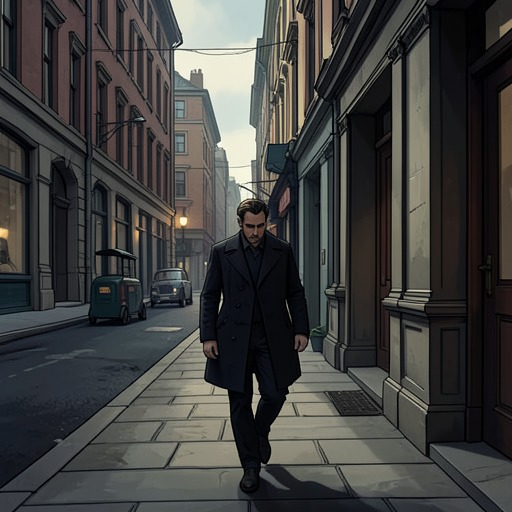
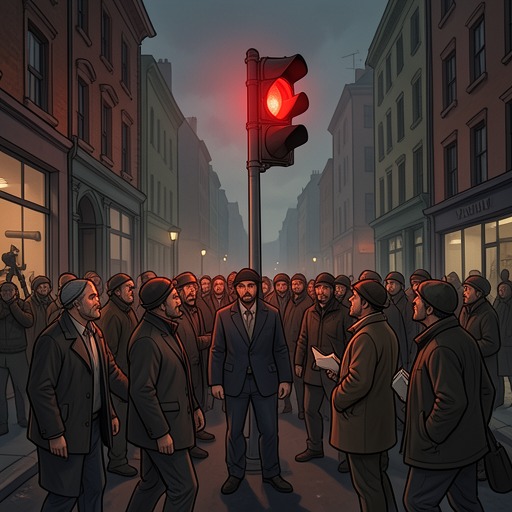
The SilenceMax walks alone into the street crowd at a moment when phones are shut down, people are surging through the city, and scattered fights and small riots punctuate the disorder. He does not join the violence or offer an explanation for it. Instead, he pauses to watch, then steps into the moving mass. The action brings his earlier condemnation of technological dependence into contact with its immediate human aftermath: people must negotiate one another directly, without the devices that had occupied their attention and helped them move through the world.
Departure from the Conversation
Before the street scene, Max stands and stretches, and the sound of his name—Max Stenner, Max—silences a young man who has been speaking earnestly, perhaps as himself or as Einstein. The surrounding conversation concerns Einstein’s parents, and Max’s abrupt physical presence interrupts its intellectual momentum. He describes people as being zombified and bird-brained, then walks toward the front door, continuing to speak over his shoulder. His complaint is pointed at a condition shared by the people around him, not just at the young man’s performance.
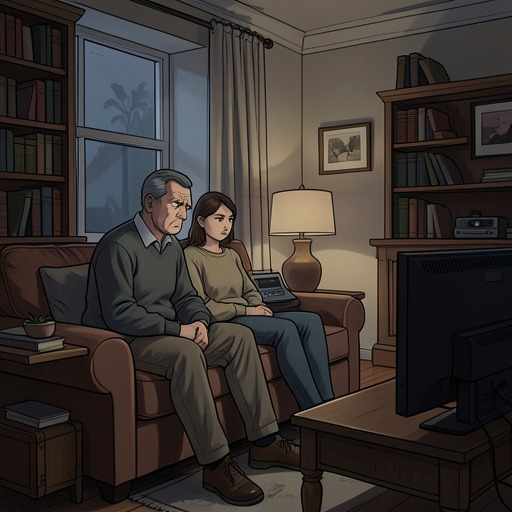
Max calls the day his expiration date, but cannot settle whether it is Sunday or Monday and gives only an uncertain date in February. Nobody understands what he means. He zips his jacket and leaves; Diane Lucas imagines him descending the stairs one step after another. Her attention slows until she nearly feels obliged to sit before the television on his behalf, waiting for something to appear on the screen. The exit thus leaves Max moving while Diane remains inside, suspended in the expectation of a message or image that may not come.
Watching the Crowd
On the streets, Max grudgingly recalls something Martin Dekker said and wonders whether the scene before him is an aspect of Martin’s mind repositioned in three dimensions. The thought does not explain the crowd; it makes the crowd harder to classify. Max tests the possibility outward, asking himself whether people in other cities are also rampaging, whether crowds in Canada might spill into the crowds here, and whether public squares in Europe, Asia, and Africa are equally swarming. The scale of the crisis reaches him as a chain of questions rather than as verified knowledge.
The passing names of countries occupy his mind alongside the people trying to speak to him and to one another. For one compressed, claustrophobic moment, he forgets the names of his daughter who lives in Boston with two children and a husband, and of his other daughter, who is traveling somewhere. The lapse briefly makes the worldwide crowd and his nearest family part of the same pressure on memory: he can enumerate places, yet loses hold of the names that ought to be most familiar. The narration stays close to this unsettled, shifting attention without supplying a larger account of what is happening elsewhere.
The Pause and the Decision to Enter
Max stands against a wall and watches. He contrasts the present with more ordinary times, when people stared into their phones in the middle of the sidewalk, absorbed in their devices or veering around others without looking up. Now the phones have shut down along with everything else. The familiar image of people enthralled by screens returns in altered form: their attention is no longer fixed on devices, but the shared technological failure has not produced calm or easy contact. People hurry, confront one another, and fill the street without a dependable system to organize their movement.
He tells himself it is time to head home, though getting there will mean forcing his way through the crowd. He registers people hunched against the cold, faces passing by the thousand, people wrestling and throwing punches, small riots, and curses rising in the air. Before moving, he flexes his shoulders as if preparing for the effort. He also decides that, once he reaches his building, he will count the steps up to his apartment—a practice he has not used for many decades—and immediately wonders what the point of doing so would be. The small, countable staircase offers a contrast to the scale and unpredictability of the street, but even this familiar measure cannot give him a settled reason for proceeding. After standing for a few seconds longer, he walks into the streaming mass.
Return and Significance
A later scene shows Max walking back in while the others wait for him to speak. He removes his jacket and throws it on the floor beside the remote control, a bottle of bourbon, and an empty glass; then he pours a drink and reacts to the raw whiskey’s bracing shock. When asked what is happening in the streets and who is out there, he answers that they do not want to know. The return supplies a concrete endpoint to the passage through the crowd, but not an account of what he encountered or a resolution of the disorder. His brief reply leaves the outside world present as something the people inside would rather not hear about.
The action’s force lies in this movement between rooms and streets, and between watching and entering. Max first leaves after naming technological dependence as a form of mental diminishment; outside, he sees the shutdown of devices alongside confusion, violence, and people trying to communicate. He pauses, entertains an uncertain connection between the crowd and Martin Dekker’s mind, loses his daughters’ names for an instant, and then moves on without arriving at an explanation. The later bourbon and refusal to describe the street preserve that uncertainty. His walk is therefore not a triumphant escape from technology or a deliberate confrontation with the crowd, but a passage through a crisis whose full scope he can imagine more readily than he can know.